
Working carers at tipping point
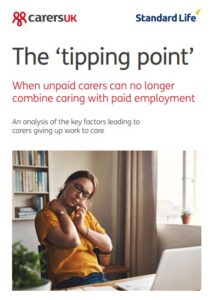
Working carers at tipping point – new report from Carers UK
A new report from Carers UK shows the huge challenges working carers face when trying to stay in employment – and makes recommendations to what must change.
It’s called The tipping point: when unpaid carers can no longer combine caring with paid employment.
Nearly half of working carers (47%) are considering leaving work or reducing their hours
The report, supported by Standard Life, provides a clear picture of the intersecting pressures that can push carers out of the labour market and explores the practical support that can prevent carers from giving up work to care.
 Drawing on responses from over 10,500 carers and in-depth interviews with carers, the research shows how people are pushed to a breaking point, where continuing to work is simply no longer possible. Concerningly, it finds that nearly half of working carers (47%) are considering leaving work or reducing their hours.
Behind this statistic are hundreds of thousands of people trying to balance work alongside their caring responsibilities – often at significant personal and financial cost. Being out of work is the single strongest quantitative predictor of poverty for unpaid carers.
With the Government’s consultation on employment rights for unpaid carers set to launch in the coming weeks, Carers UK’s message is clear – carers need more support to stay in work, including access to paid Carer’s Leave.
What pushes carers to that tipping point?
Many carers said they didn’t want to leave work – but felt they had no choice. Carers reported that it’s rarely one single factor, but a combination of pressures:
- Workplaces that don’t adapt: Many carers lack flexible working or supportive policies. Almost half (48%) don’t feel comfortable discussing caring with their manager.
- Gaps in social care and support services: The most commonly cited factor that could have kept carers in work was access to affordable, reliable social care services.
- Deteriorating health: 77% said they went to work while unwell; 71% felt stressed or anxious while working. Caring needs increasing over time: As conditions worsen or responsibilities grow, work becomes harder to sustain.
Why this matters:
Unless urgent action is taken, an increasing number of unpaid carers will reach this tipping point and be left with little choice but to give up paid employment – affecting their income, pension, ability to manage financially in the future, and their health and wellbeing.
This is bad for families, bad for employers, and bad for the economy. The Government estimated in 2025 that the cost of carers being unable to participate in paid employment is £37 billion a year.
Carers UK’s recommendations for change:
Preventing carers from reaching this tipping point requires coordinated action across Government, employers, and public services, including the NHS and social care.
As a result, Carers UK is calling for:
- A strategic approach to supporting carers
The UK Government to develop a fully funded, cross-Government Carers Action Plan that prioritises keeping unpaid carers in work and recognises the economic cost of inaction. The Casey Commission on adult social care reform also must ensure that unpaid carers are at the heart of its recommendations for change and recognise that social care is important infrastructure that enables carers to participate in paid work. - A statutory right to paid Carer’s Leave
The Government’s forthcoming consultation on employment rights for carers offers a crucial opportunity to introduce a statutory right to paid Carer’s Leave, giving carers a realistic chance of staying in employment. - Strengthened employer support
More employers need to implement practical support to retain skilled employees with caring responsibilities, including flexible working, dedicated carer policies, manager training, and workplace support networks. - Investment in social care and NHS support
UK Government needs to provide sustainable funding for social care, improved access to replacement care, and stronger NHS recognition and support for carers, to protect their health and ability to remain in work. - Improved financial support for carers
Carers UK is calling for reforms to Carer’s Allowance and the wider benefits system to reduce financial hardship, support carers to stay in employment where possible, and improve long-term financial security.
Find out more:
Download Carers UK’s full report and recommendations here: https://go.carersuk.org/TippingPoint